
A young woman’s journey to becoming a pilot
Women represent less than 7% of all pilots – that figure becomes even more minuscule when you discount female pilots who only hold student licences, which takes the number down to a mere 4.94%, according to Pilot Institute.
Fareeha Ahmed has completed her Private Pilot’s Licence, passed all 14 ATPL (Airline Transport Pilot Licence) theory exams and is now building up her flying hours before commencing the last phase of her advanced training to become a commercial pilot. As the aviation industry recovers from Covid-19, this 21-year-old, who’s ready for take-off, quite literally, finds time in her schedule to let me into her world.
“I think most people’s perceptions of being a pilot is to get in an aircraft, press the autopilot button and then have a few days off on holiday,” Fareeha tells me. She recites a famous quote that says, ‘A true pilot is always learning’, and admits she never understood what it meant until she started training. “What people don’t see is the endless hours spent studying exam after exam,” she says, telling me that a pilot is expected to understand a broad range of topics, including the laws of the air, meteorology, human performance and radio navigation. Yet the hard work doesn’t affect her enthusiasm: “It has been the best experience of my life. Taking to the skies, meeting others who share the same passion and studying towards my dream goal has never been more rewarding.”
To be so resilient in an industry where women are rarely seen takes sheer determination, so I’m curious to know how it all started. “I’ve had the aviation bug for as long as I can remember,” Fareeha recalls. “Being fortunate to travel as a child, I was always so fascinated at the airport with my eyes glued to the aircraft parked up at the terminal and taking off on the runway. As I got older, my eyes were constantly looking up at the sky and I became a plane spotter without even realising. It got to the point where even my best friend would be able to point out an A380 in the sky because of how much I talked about it.”
As for what her family and friends think, she tells me they have been nothing but supportive, which is not what she imagined. “I remember sitting down with [my mum] one day when I realised I wanted to become a commercial pilot. I could barely get the words out as I was so nervous that she wouldn’t be happy with my plans. However, it was quite the opposite. Before I had even finished talking, she said, ‘Go for it. Whatever you need to do for it, I will be right here to support you’ – and that has been the case ever since,” Fareeha enthuses. “I am so grateful for the support I’ve had around me; it’s honestly made me want to be the best I can ever be.”
I can’t help wondering what such a pioneering woman was like growing up. “In school, I was a very quiet and shy child. I kept to myself a lot and had my head down,” she explains, quickly ending any assumptions I might have had about her being the super confident pupil. “I always had the same comment in my end of year report: ‘Fareeha is a delight to teach but she needs to speak more in class’. While I am not the ultimate outgoer now, I have found my confidence and take such joy in interacting with others, both academically and socially – another thing I am so grateful about going to university for.”
Going back to the subject of gender, I want to know what it’s like working in an industry where women are so underrepresented. “When starting my journey, I felt very apprehensive and nervous. In most cases, I was very visibly the odd one out in a class full of males and this made me very self-conscious,” she recalls. But while she thought she’d have to work 10 times harder to prove herself, she was delightfully surprised. “I found that I was not treated any differently than my peers, and, in fact, I felt like many people made the extra effort to make sure the small group of us didn’t feel left out. I’ve been lucky enough to have flown with two female instructors who constantly encouraged me to be the best I could possibly be, even when I felt out of place. This massively built up my confidence.”
During her training, she’s also campaigned for the Women in Flight scholarship. Reflecting on her experience, she says, “Shortly after posting a picture on LinkedIn, I was flooded with messages from girls in STEM subjects or aspiring pilots expressing their apprehensions. It really emphasised to me how many other girls felt the same way I did when starting out, and I wanted to do something about it.”
“A pilot’s uniform is generally associated with hard work and determination, so I wear it with my head held high every time”
Fareeha worked closely with the Head of Aviation at Buckinghamshire New University (where she studied up to master’s level) and became a course ambassador. Through mentoring and talks, she encouraged girls who shared their concerns about entering the industry to not worry – something she wishes she’d had when starting her journey. Since then, she’s seen “more girls than ever” taking the pilot course. “I will continue to champion this change and use myself as an example to encourage those who want to pursue their dreams without letting anything stop them,” she enthuses.
As for how she organises her day around training and studying: “I cannot live peacefully without weekly schedules. This allows me to have a visual representation of my week and ensures that I don’t skip anything,” she explains. “I like to think I am most productive first thing in the morning with my cup of coffee, but I do also like to occasionally work through the night if I have a pressing task – usually a university assignment.”
She reveals she had “instant tears” after receiving the results of her last ATPL exams. “The relief of seven months of extremely hard work paying off was a feeling I will never forget,” she remembers, before gushing about how fortunate she was to be able to visit Qatar – now her number one destination.

So, which airline she would love to work for? “During the beginning of my training, I had my heart set on going corporate and flying private jets. Then I had visions of me flying out of the Middle East, and now I want to be hopping around Europe. At the moment, I am very flexible – I just want to be up in the air!”
I ask her what personality type she is (assuming she knows – she seems very self-aware, after all). “I am 51% introverted and 49% extroverted, and I think it’s a true reflection of how I have developed during the course of my training. I used to be very much an introvert and kept to myself, however after being pushed out of my comfort zone, I’ve definitely grown to be more outgoing,” she reveals. “I believe that the biggest attribute a pilot should have is determination. Flight training is not easy, and there are so many ups and downs you will face during your journey – which is perfectly normal. However, the most successful people will be those that continue to persevere and work through the hard times.”
Despite the aviation industry being one of the hardest hit sectors to suffer from the pandemic, she continues to be hopeful, highlighting that airlines are now preparing for what she refers to as “the sky-rocketing demand of passenger travel”.
“Every aviator jumper or jacket I have ever seen has only been made for men. I would love for there to be more choices for women, rather than having to settle for just a smaller men’s size”
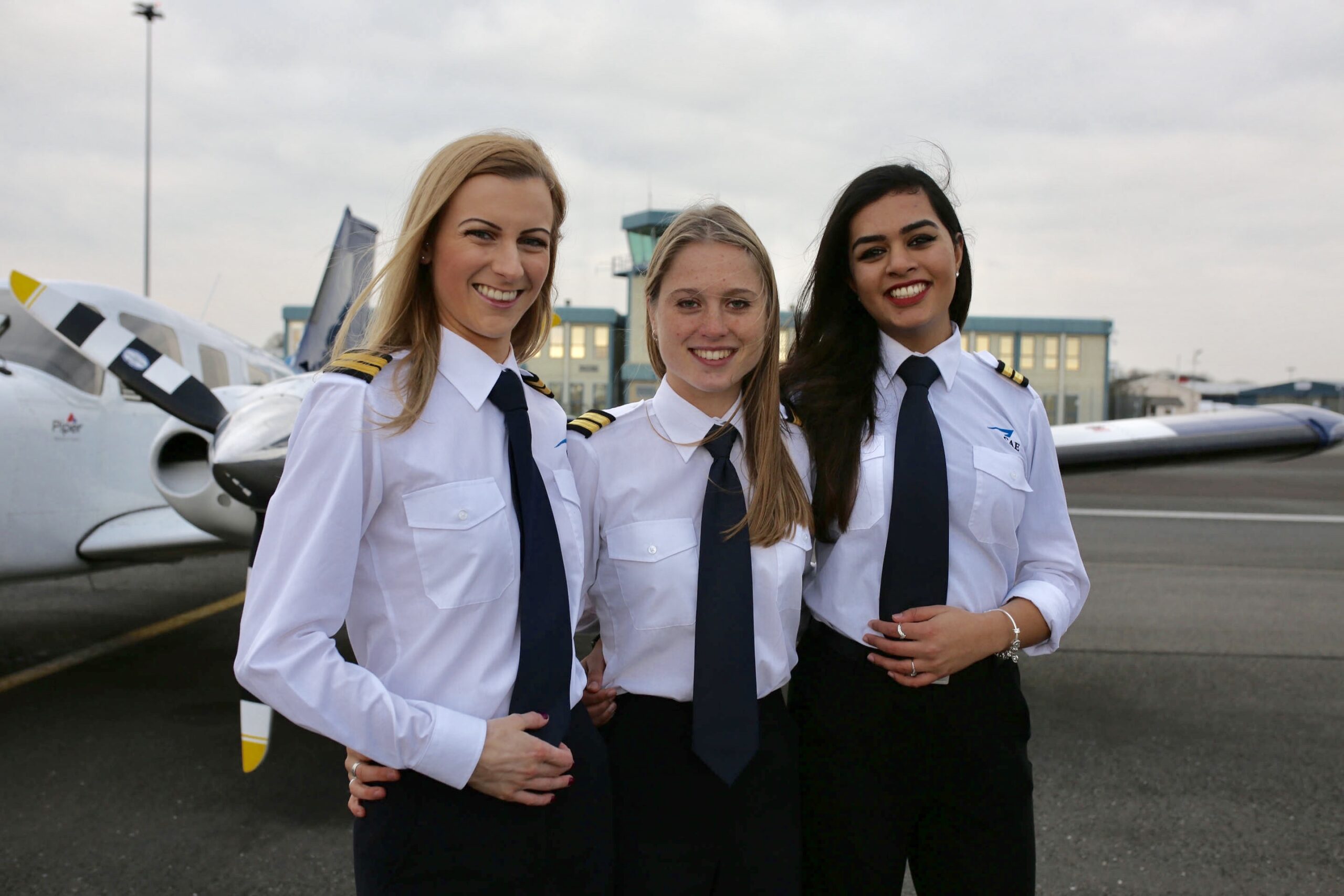
Lastly, Fareeha tells me what she thinks of the uniforms in the aviation industry: “I absolutely love the uniform and the sense of pride associated with wearing it. I recently put my uniform on, having not worn it for almost a year, and I felt absolute joy when looking at myself in the mirror. A pilot’s uniform is generally associated with hard work and determination, so I wear it with my head held high every time,” she enthuses. Fareeha does, however, notice the lack of female pilot clothing: “Apart from shirts, every aviator jumper or jacket I have ever seen has only been made for men. I would love for there to be more choices for women, rather than having to settle for just a smaller men’s size,” she says, highlighting the need for uniform that accentuates women’s figures.
I can imagine the frustration, especially in an industry where self-presentation is so key. “We are always taught to have clean, pressed shirts, top buttons done up and ties at the correct length. This has taught us strong discipline and an even better appreciation towards the high standards of the industry, right from day one.